
In Vivo Infectious Disease Models
In Vivo Infectious Disease Models
Infectious diseases involve complex dynamics, including pathogen dissemination, tissue tropism, and host immune responses. To bridge the gap between isolated in vitro systems and native physiological responses, in vivo models serve as a critical translational step.
Each with established expertise and a broad portfolio of clinically relevant infectious disease models, WuXi Biology and Testing work together to support the preclinical evaluation of both therapeutics and vaccines across viral, bacterial, and fungal pathogens.
The platform supports therapeutic efficacy, vaccine protection, and pharmacodynamic and pharmacokinetic (PK/PD) assessment, contributing to advance candidate selection. Additionally, the platform supports related pathology and immunology assays, such as cytokine quantification, gene expression analysis, and immune marker evaluation, addressing a broad range of preclinical research and development needs.
In Vivo Models Across Infectious Diseases
WuXi Biology and Testing provides established in vivo infection models across viral, bacterial, and fungal pathogens. Disease-relevant models and study designs support evaluation of therapeutic efficacy, pathogen burden, host responses, and PK/PD relationships across anti-infective discovery and preclinical development.

Viral Infection Models
Our in vivo antiviral capabilities span multiple viral families and infection models, supporting evaluation of small molecules, antibodies, vaccines, and other therapeutic modalities.
- HBV: mouse and woodchuck models
- RSV: mouse and cotton rat infection models
- Influenza: mouse and ferret infection models
- HSV: mouse, guinea pig, and rabbit models
- HCMV: mouse models
- EV71 and other enteroviruses: mouse infection models
- Additional models across respiratory, CNS, dermatological, and reproductive viral pathogens
Bacterial and Fungal Infection Models
In vivo antibacterial and antifungal models support efficacy and PK/PD evaluation across diverse pathogens and sites of infection.
Available model types include:
- Systemic infection models
- Lung infection models
- Superficial wound models
- Deep-thigh infection models
- Gastrointestinal infection models
- Urinary tract and genital tract infection models
In Vivo Pharmacology Studies & Assessments
In vivo infectious disease studies provide an integrated framework for evaluating therapeutic activity, exposure-response relationships, host responses, and disease-related endpoints. WuXi Biology and Testing combines efficacy and PK/PD studies with complementary immunology, pathology, and pathogen assessments to support candidate characterization and preclinical decision-making.
Efficacy & PK/PD Studies
In vivo pharmacology studies can characterize therapeutic activity and establish relationships between drug exposure, pathogen burden, and pharmacodynamic response.
- Therapeutic efficacy and dose-response studies
- Pathogen burden and viral load assessment
- PK and tissue exposure
- PK/PD relationship evaluation
- Disease-relevant efficacy endpoints
- Customer-designed studies
Immunology & Pathology Assessments
Immunological and pathological endpoints can be incorporated into in vivo studies to characterize host responses and disease-related changes alongside therapeutic efficacy.
- Cytokine analysis
- Humoral and cellular immune-response assessment
- Immune-cell profiling
- Gene expression and immune marker analysis
- Histopathology
- Tissue-based assessments
Vaccine Evaluation
In vivo studies support vaccine candidate characterization through assessment of immune responses, protective efficacy, and safety in relevant challenge models.
- Immunogenicity evaluation
- Humoral and cellular immune responses
- Challenge and protection studies
- Neurovirulence evaluation
- Local and systemic toxicity
- Vector biodistribution and shedding studies
Resistance & Pathogen Characterization
Complementary pathogen characterization studies can support interpretation of in vivo efficacy and provide additional insight into susceptibility, resistance, and therapeutic activity.
- Resistance profiling
- Genotypic spectrum evaluation
- Cross-resistance studies
- Phenotyping
- Drug combination studies
- De novo selection of drug-resistant viruses
Hepatitis B Virus (HBV) In Vivo Pharmacology Platform
Chronic hepatitis B (CHB) is a severe public health burden and an unmet medical need. Current standard therapies, interferon-α and nucleot(s)ides, cannot eliminate HBV. Recently, various novel targets and approaches are being explored toward the cure of CHB. Our Biology HBV team, led by a group of experienced scientists with in-depth knowledge of anti-HBV drug discovery, has established and continues to provide an open-access, full-range integrated HBV platform for our clients, including animal models and clinical virology assays. Our HBV team is your ideal partner for the discovery and development of novel anti-HBV agents.
HBV Animal Models
A range of established HBV animal models enables selection of an appropriate system according to therapeutic mechanism and study objectives.
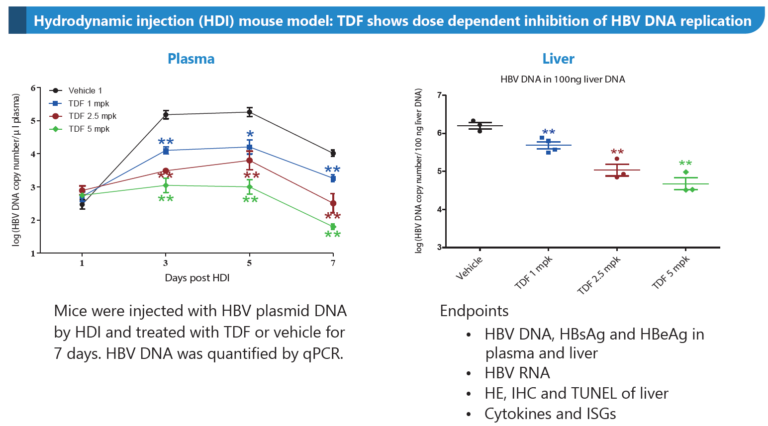
- Hydrodynamic injection (HDI) mouse model
- AAV/HBV mouse model
- Humanized FRG mouse model
- Transgenic mouse model
- WHV/woodchuck model
PK/PD Study and HBV Related Immunology Assays
HBV animal studies can be complemented by PK/PD and immunological assessments to characterize therapeutic response, pharmacodynamic activity, and host immune responses.
- Cytokines by ELISA, Luminex and MSD
- IFN and ISG mRNA by ELISA and RT-qPCR
- Immune markers by IHC, IF and Western blot
- Splenocytes, lymphocytes from organs and PBMC by FACS, ICS and ELISPOT
Hepatitis C Virus (HCV)
Hepatitis C virus programs require sensitive virological methods to characterize viral response and support the evaluation of antiviral therapies. WuXi Biology and Testing provides clinical virology capabilities to support HCV programs through viral load measurement, genotyping, and phenotypic characterization, helping assess viral susceptibility and treatment response through clinical development.
Capabilities include:
- Viral Load (Cobas)
- Genotyping
- Phenotyping
- Chimera-based phenotypic analysis
- Site-directed mutagenesis (SDM)
- Viral fitness assessment
- Drug susceptibility testing
Respiratory Virus In Vivo Models
WuXi Biology and Testing provides in vivo models for respiratory viral infections to evaluate therapeutic efficacy, viral burden, immune responses, and disease-related endpoints. Available models support evaluation of small molecules, antibodies, oligos, vaccines, ADC, DFC, and other antiviral modalities.
Respiratory Syncytial Virus (RSV) In Vivo Models
Mouse and cotton rat RSV infection models support efficacy and immunogenicity studies using established virological, immunological, and pathological endpoints.
- Mouse nasal infection models
- Cotton rat nasal infection models
- RSV A and B strain evaluation
- Viral load and tissue viral titer
- Humoral and cellular immune-response assessment
- Lung histopathology
- Small-molecule and antibody efficacy evaluation
Influenza & Other Respiratory Virus Models
Additional respiratory virus models extend in vivo pharmacology capabilities beyond RSV.
- Influenza mouse infection models
- Influenza ferret infection models
- Human metapneumovirus mouse models
- Human rhinovirus mouse models
- Additional respiratory virus models based on study requirements
Clinical & Translational Virology Support (CAP Lab)
Complementary clinical virology and bioanalytical capabilities can extend infectious disease programs beyond preclinical pharmacology, supporting characterization of viral response and translational endpoints through clinical development.
HBV & HCV Clinical Virology
- Viral Load (Cobas)
- Genomic Profiling: Pol, core, full-length genome analysis, Sanger method (clone and population), high-depth mutational analysis
- Genotyping by INNO-LiPA
- Phenotyping
- HBV emerging viral markers: serum HBV RNA, HBcrAg
Translational & Clinical Bioanalysis
Clinical and translational bioanalysis capabilities support the evaluation of treatment-related responses.
- Clinical virology
- Vaccine immune-response analysis
- Neutralization testing
- PK/PD assessment
- Biomarker analysis

Explore Solutions for Your Program
Explore solutions by development phase, drug modality, therapeutic area, or integrated discovery needs.
You May Also Be Interested In



Get a Quote
Ready to plan your next study? Share your program needs with our team for a tailored estimate.
WuXi Biology and Testing offers in vivo models for a broad range of pathogens, including viruses (eg, HBV, HCV, RSV, influenza, hMPV, HSV, VZV, EV71, DEHV, HCMV), bacteria (eg, S. aureus, K. pneumoniae, P. aeruginosa, E.coli, A. baumanni, Listeria monocytogenes), fungi (eg, C. albicans, Aspergillus spp.), and mycoplasma. Available animal models include mouse, rat, ferret, cotton rat, humanized and transgenic mice, and woodchuck systems, selected according to the pathogens and study objective.
These models support antiviral discovery and preclinical evaluation by enabling efficacy assessment, PK/PD characterization, immune response profiling, and histopathology, thus informing candidate selection for IND-enabling studies.
Available HBV models include hydrodynamic injection (HDI), AAV/HBV, humanized FRG, transgenic mouse, and WHV/woodchuck models. These options support evaluation of antiviral activity and other preclinical study objectives.
Related immunology assays can assess cytokines, IFN and ISG mRNA, immune markers, and immune-cell populations using platforms such as ELISA, Luminex, MSD, RT-qPCR, IHC, immunofluorescence, Western blot, FACS, ICS, and ELISPOT.
Yes. The platform supports preclinical antiviral and antimicrobial studies as well as clinical virology services such as viral-load measurement, genotyping, phenotyping, and emerging HBV marker assessment in clinical samples.