
Target Identification and Validation
Build Drug Discovery on a Validated Therapeutic Target
Drug discovery begins by identifying a therapeutic target that plays a meaningful role in disease biology, then generating the evidence needed to confirm that modulating it can produce the desired biological effect. This target identification and validation phase establishes the scientific foundation for every subsequent stage of discovery, from hit finding through lead optimization and candidate selection.
WuXi Biology and Testing provides integrated target identification and validation solutions that combine functional genomics, target deconvolution, chemical proteomics, structural biology, and cellular and biochemical assays. By identifying biologically relevant, tractable targets before significant resources are committed, we help reduce downstream risk and improve confidence throughout drug discovery.
Drug Discovery Success
Build Discovery on a High-Confidence Target
Successful drug discovery starts with selecting the right biological target. Confirming disease relevance, mechanism of action, target engagement, and tractability before entering hit finding provides a stronger scientific foundation for downstream discovery. By establishing confidence in the target early, researchers can reduce development risk, make better-informed decisions, and improve the likelihood of identifying successful drug candidates.
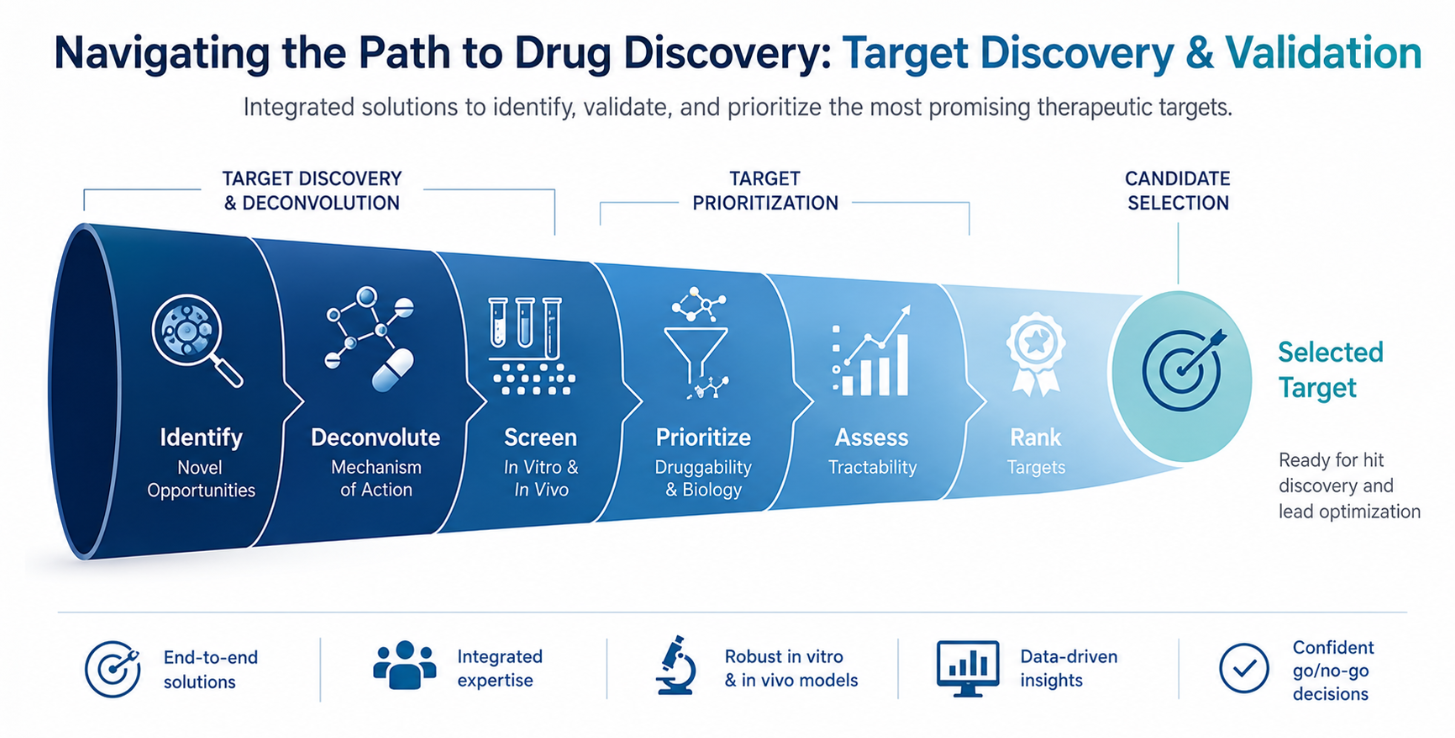
From Disease Biology to a Validated Therapeutic Target
Challenges
Disease biology often points to multiple potential targets, making it difficult to determine which one is most likely to drive therapeutic benefit.
Solutions
We combine functional biology, disease models, and integrated discovery approaches to identify and prioritize targets with the strongest biological evidence. By narrowing the field early, we help focus resources on the most promising opportunities before hit finding begins.
Challenges
A phenotypic hit or bioactive compound demonstrates activity, but the molecular target and underlying mechanism remain unclear.
Solutions
We apply complementary target deconvolution strategies to uncover the protein or pathway responsible for the observed activity and generate the mechanistic understanding needed to confidently advance the program.
Challenges
A potential therapeutic target has been identified, but its role in disease and its ability to produce meaningful biological effects still need to be demonstrated.
Solutions
We generate orthogonal biological evidence to confirm target function, mechanism of action, and disease relevance using complementary cellular and biochemical approaches, helping reduce uncertainty before significant discovery investment.
Challenges
Addressing modality-specific considerations early in drug discovery is critical to selecting the most appropriate target validation strategy. Different therapeutic modalities require different types of biological and mechanistic evidence to demonstrate that a target can be successfully modulated and advanced with confidence into hit finding.
Solutions
We tailor target identification and validation strategies to the intended therapeutic modality. By integrating functional genomics, target deconvolution, structural biology, biochemical and cellular assays, and translational models, we generate the modality-specific evidence needed to evaluate target tractability and support successful hit finding across small molecules, biologics, ADCs, targeted protein degraders, oligonucleotides, gene therapies, cell therapies, radiopharmaceuticals, and other emerging modalities.
Identify Therapeutic Targets and Uncover Mechanisms
Target identification can begin in two ways: by discovering new therapeutic targets from disease biology or by determining the molecular target responsible for the activity of a phenotypic hit or bioactive compound. Together, these complementary approaches establish the biological foundation for successful drug discovery.
WuXi Biology and Testing integrates functional genomics with advanced target deconvolution strategies to identify disease-relevant targets and reveal mechanisms of action. Our capabilities include:
- Functional genomics screening
- Target deconvolution
- Chemical proteomics
- Proximity labeling
- Co-immunoprecipitation (Co-IP)
- Disease-relevant cellular and in vivo models
Validate Biological Relevance
Once a candidate target has been identified, it is essential to demonstrate that modulating it produces the desired biological response. Building multiple lines of biological evidence helps establish the mechanism of action, confirm disease relevance, and reduce uncertainty before hit finding begins.
We integrate complementary cellular and biochemical approaches to validate target function and characterize biological mechanisms, including:
- Cell engineering
- Target engagement assays
- Signal transduction assays
- Cellular functional assays
- Biochemical activity assays
- Biomarker analysis
Assess Target Tractability
Not every biologically relevant target can be successfully modulated by a therapeutic molecule. Early tractability assessment helps determine whether a target is suitable for drug discovery and supports informed target prioritization before screening campaigns begin.
We combine ligandability assessment with structural and screening technologies to evaluate target tractability, including:
- DNA-encoded library (DEL) screening
- Structure-based drug design
- Biophysical characterization
- Ligandability assessment
- Early hit generation strategies
Assess Target Tractability
High-confidence target validation provides the biological foundation for successful hit discovery. By integrating target biology, mechanistic understanding, and tractability assessment, researchers can move into hit finding with greater confidence and a lower risk of downstream attrition.
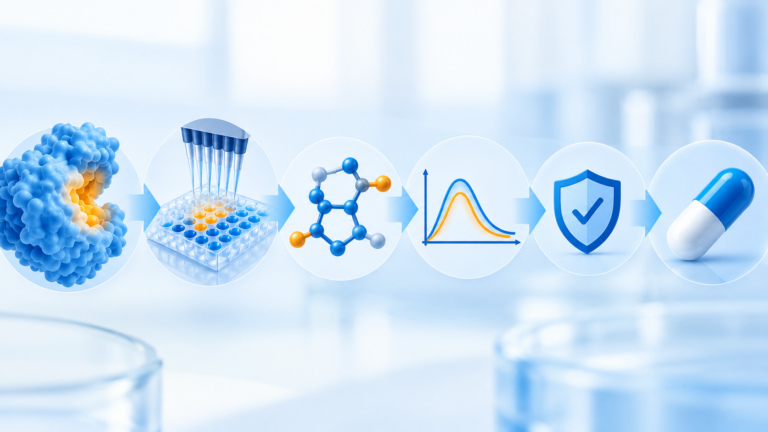
We provide an integrated discovery platform that connects target identification and validation with the next stages of drug discovery, including:
- Hit finding
- Hit-to-lead
- Lead optimization
- DMPK
- Bioanalysis
- Safety assessment
Related Services
You May Also Be Interested In

Discuss Your Program with Us
Share your development goals and key challenges with our experts to define the right path forward.
Frequently Asked Questions about Target Identification and Validation
Target identification and validation is the process of identifying a gene, protein, or biological pathway involved in disease and confirming that modulating it produces the intended biological effect. It establishes the biological foundation for a drug discovery program by ensuring the selected therapeutic target is relevant, actionable, and suitable for further development before hit finding begins.
Target discovery is the overall process of finding and evaluating potential therapeutic targets. Target identification focuses on selecting specific genes, proteins, or pathways associated with disease biology, while target validation confirms that modulating those targets produces a meaningful biological effect and that they are suitable for drug discovery.
Choosing the right therapeutic target is one of the most important decisions in drug discovery. Confirming disease relevance, mechanism of action, target engagement, and tractability before investing in hit finding, lead optimization, and preclinical development helps reduce development risk, improve decision-making, and increase the likelihood of clinical success.
Target deconvolution is the process of identifying the molecular target responsible for the activity of a phenotypic hit or bioactive compound with an unknown mechanism of action. It is commonly used in phenotypic drug discovery to reveal the underlying target, enabling downstream target validation, mechanism-of-action studies, and hit optimization.
Target tractability assessment evaluates whether a biologically validated target can realistically be modulated by a therapeutic agent, such as a small molecule, antibody, peptide, or other modality. By combining ligandability, structural biology, and experimental evidence, tractability assessment helps prioritize targets with the greatest potential for successful drug discovery.
Target identification and validation is the first stage of the drug discovery workflow. It precedes hit finding, hit-to-lead, lead optimization, and candidate selection by establishing a biologically validated and tractable therapeutic target, providing a stronger scientific foundation for every subsequent stage of drug discovery.
Target identification determines which gene, protein, or biological pathway should be therapeutically targeted in a disease. Target engagement confirms that a drug candidate physically binds to and modulates that intended target in cells or tissues. Target identification occurs at the beginning of drug discovery, while target engagement is typically measured later during hit finding, lead optimization, and translational studies to confirm a compound's mechanism of action.
We tailor target identification and validation strategies to the biology and mechanism of each therapeutic modality. Our integrated platform supports small molecules, biologics, antibody-drug conjugates (ADCs), targeted protein degraders, oligonucleotides, radiopharmaceuticals, cell therapies, gene therapies, and other emerging modalities by combining functional genomics, target deconvolution, protein science, biochemical and cell-based assays, proteomics, phenotypic characterization, and disease-relevant models. This integrated approach helps generate the modality-specific biological evidence needed to assess target relevance, tractability, and therapeutic potential before advancing to hit discovery.