
Dose-Range Finding Studies and MTD Studies
Establish Optimal Dosing for Regulatory Success
Dose-range finding or maximum tolerated dose (MTD) studies represent the critical first stage of safety assessments. At WuXi Biology and Testing, we design these preliminary evaluations to help every drug developer identify the appropriate dose levels required for later regulatory studies, including single-dose and repeat-dose toxicity programs.
By the Numbers
General Tox Studies Performed
Sq Ft of Lab Testing Space
Environmentally Controlled Animal Rooms
Dose-Ranging Services and Testing Capabilities
We provide comprehensive dose-range finding studies to support all stages of drug development, including IND-enabling and repeat dose toxicity assessments.
Dose-Range Finding in Drug Development
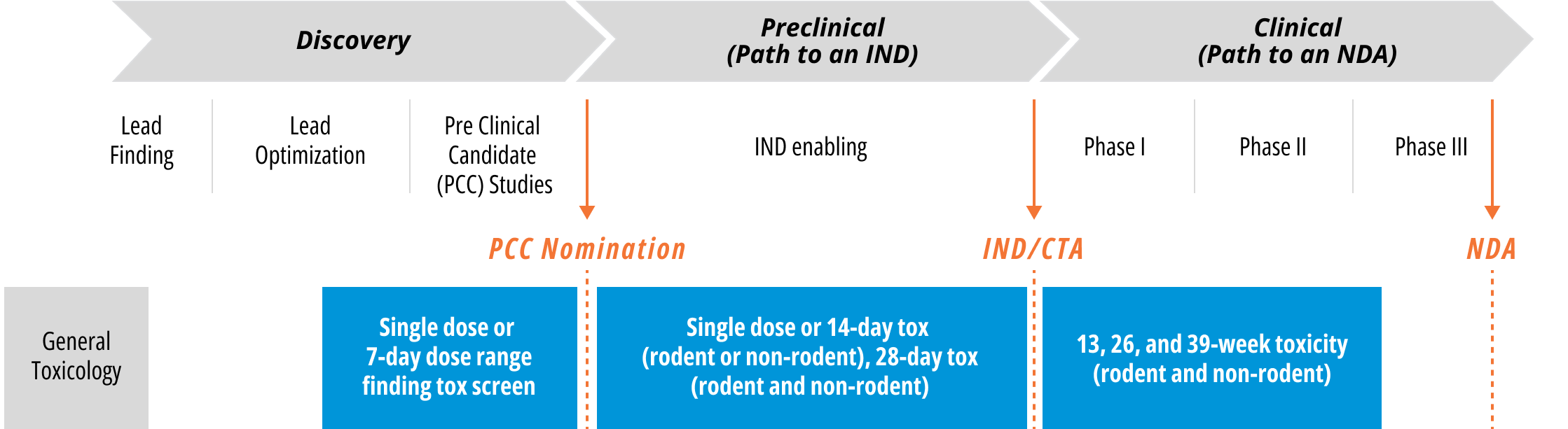
Our dose-ranging studies provide the proper data you need to inform later-stage clinical trials. Here’s an overview of which data you can expect to receive in the form of a chart. Dose-range finding is a critical part of the drug development lifecycle, playing important roles through the discovery, preclinical to IND, and clinical stages.
Statistical Considerations in Dose Selection
Selecting appropriate dose levels is critical for meaningful dose range-finding studies. Our statistical methodologies help you optimize dose escalation and study design by ensuring:
- A sufficient range of doses to observe potential effects.
- Dose spacing that captures toxicity thresholds without excessive animal use.
- Robust data collection to determine the maximum tolerated dose (MTD).
Regulatory Guidance
Our experts ensure your program adheres to all requisite regulatory standards and guidelines, facilitating a smooth transition from submission and approval to clinical development. We align your protocols with:
- US Regulatory Agencies and Global Counterparts: Guidance on selecting starting doses for clinical trials.
- ICH M3(R2): Recommendations on preclinical safety evaluation for pharmaceuticals.
- OECD Guidelines: International standards for testing chemicals and characterizing toxicological profiles.
Integration With Clinical Development
Preclinical dose-ranging studies are crucial to shaping clinical trial design. Our integrated approach helps drug developers optimize decision-making and development pathways by:
- Determining safe starting doses for first-in-human studies.
- Establishing safety margins for therapeutic dosing.
- Predicting potential adverse effects and guiding risk mitigation strategies.
Other General Toxicology Studies
As an end-to-end toxicology testing partner, we offer a full suite of dose studies tailored to your compound needs. Beyond dose range-finding, this includes single-dose acute toxicity testing and repeat-dose chronic toxicity studies.

Explore Solutions for Your Program
Explore solutions by development phase, drug modality, therapeutic area, or integrated discovery needs.
You May Also Be Interested In





Get a Quote
Ready to plan your next study? Share your program needs with our team for a tailored estimate.
Dose-Ranging Studies FAQ
Dose range-finding studies are an essential precursor to pivotal studies:
- Single dose acute toxicity studies identify potential adverse effects of the new drug candidate.
- Repeat dose chronic toxicity studies evaluate the effects of repeat administration over a defined period of time.
Unless your clinical plan is only a single dose, your pivotal, or IND-enabling, study will more often than not be a repeat dose study for 14-28 days. This study is critical to your IND approval and requires a robust protocol, an experienced laboratory that will generate and interpret quality data, and GLP compliance. Because of the rigorous standards for GLP pivotal studies it’s important to have the best data available informing your study design before you initiate the GLP study. Dose range-finding studies are how you get there.
Dose range-finding studies help you learn a lot about your drug beyond just dose level.
For example, when you take blood samples to look at the pharmacokinetics (PK) of the drug in the animals, you can correlate signs of toxicity to the drug levels and kinetics and better design the timing of in-life parameters in your GLP study.
Look for signs of toxic effects using the following parameters:
- Body weights
- Clinical observations
- Hematology
- Clinical chemistry
- Coagulation parameters
- Necropsy
- Neurological observations (for neurological drugs)
- Cytokines (for immune-stimulating drugs)
- Flow cytometry (for immunomodulatory drugs)
Ultimately, dose range-finding studies present an excellent opportunity to learn more about your drug so you’re ready for GLP and IND filing. Use this as a chance to get the most information possible so you can create a robust GLP study.
Toxicology studies that result in too much toxicity or none at all are not ideal. If doses are too high, you may not have a NOAEL (No Observable Adverse Effect Level) that is used to calculate the starting dose in the clinic. If you have no toxic effects and can demonstrate sufficient exposure, you may have to use a maximum feasible dose approach to assign a high dose (see again ICH M3R2 Figure 1). Dose range-finding studies can be repeated until you find the appropriate dose and route of administration. This is much more cost effective than repeating a GLP study.
Non-GLP dose range-finding (DRF) studies help drug developers select the appropriate doses for later pivotal regulatory studies.
14-28 days.
Dose range-finding studies help you learn a lot about your drug beyond just dose level. For example, when you take blood samples to look at the pharmacokinetics (PK) of the drug in the animals, you can correlate signs of toxicity to the drug levels / kinetics and better design the timing of in-life parameters in the GLP study.