
Fragment Screening and Drug Discovery
Enhancing Discovery with High-Precision Fragment Screening
Fragment-based screening identifies low-molecular-weight compounds that bind to a biological target, often with weak affinity but high ligand efficiency. By combining compact, diverse fragment libraries with sensitive biophysical and structural methods, fragment-based drug discovery can reveal binding pockets and chemical starting points that may not be readily identified through conventional screening.
WuXi Biology and Testing offers a highly diverse technology platform designed for advanced fragment screening to facilitate target validation, enable rapid hit finding, support robust hit confirmation, and drive lead series optimization across your drug development programs.
Strategic Advantages of Fragment-Based Screening
Fragment-based drug discovery is complementary to high-throughput screening and other hit-finding approaches. Its value comes from the combination of a well-designed fragment library, sensitive detection methods, and rigorous hit validation.
- Efficient Chemical Space Sampling: Because fragments are small and structurally simple, a focused library can represent diverse chemotypes and interaction patterns with fewer compounds than a conventional screening collection.
- Access to Challenging Binding Sites: Fragments may bind shallow pockets, allosteric sites, cryptic pockets, and protein-protein interaction interfaces that can be difficult to address with larger molecules.
- Ligand-Efficient Starting Points: Although initial affinities are often weak, fragments can make efficient interactions relative to their size and provide tractable starting points for chemical expansion.
- Insight into Target Ligandability: Binding patterns, orthogonal assay results, and structural data can help assess whether a target pocket can support productive small-molecule interactions. Hit rate alone should not be used as a definitive measure of druggability.
- Flexible Hit Progression: Validated fragments can be advanced through fragment growing, merging, linking, or scaffold exploration using structure-led or activity-led design strategies.
Fragment Screening Models & Charts
Webinar on Ligand-Based Fragment Discovery
Fragment Screening Options
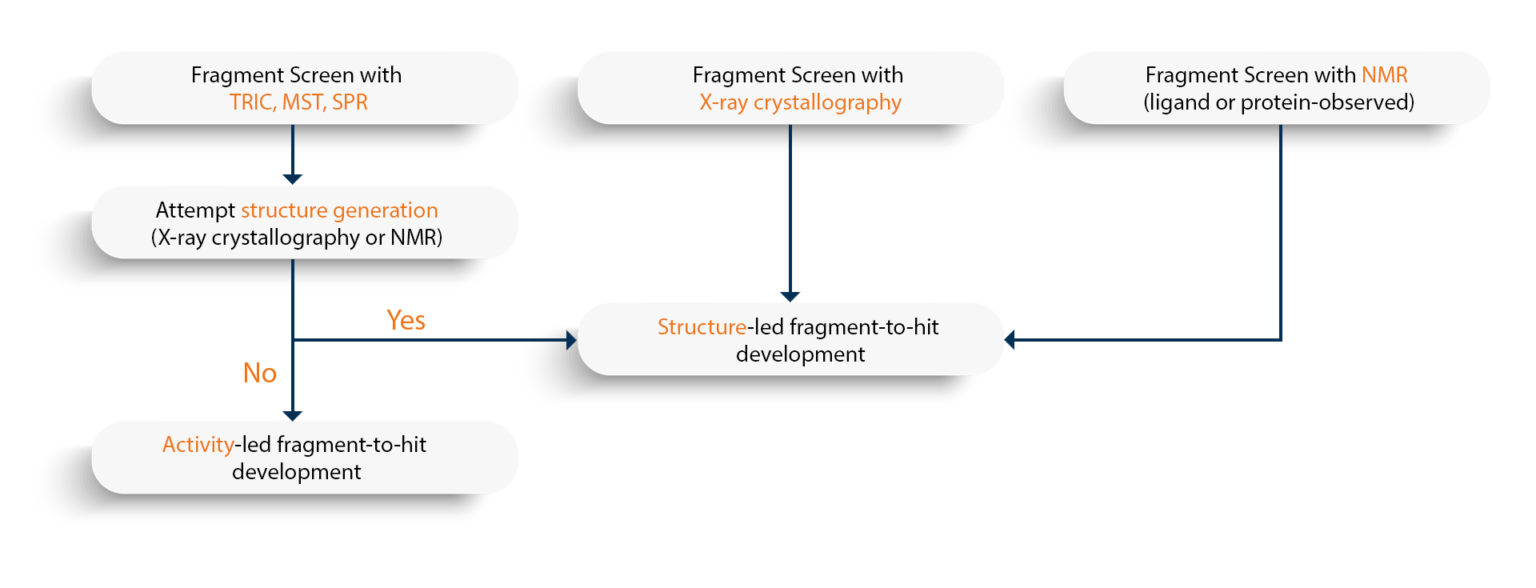
Fragment screening strategies should be selected according to the target, protein construct, available assay formats, and intended follow-up studies. Multiple screening and confirmation technologies may be combined to provide complementary information on fragment binding, affinity, binding sites, functional effects, and potential assay artifacts.
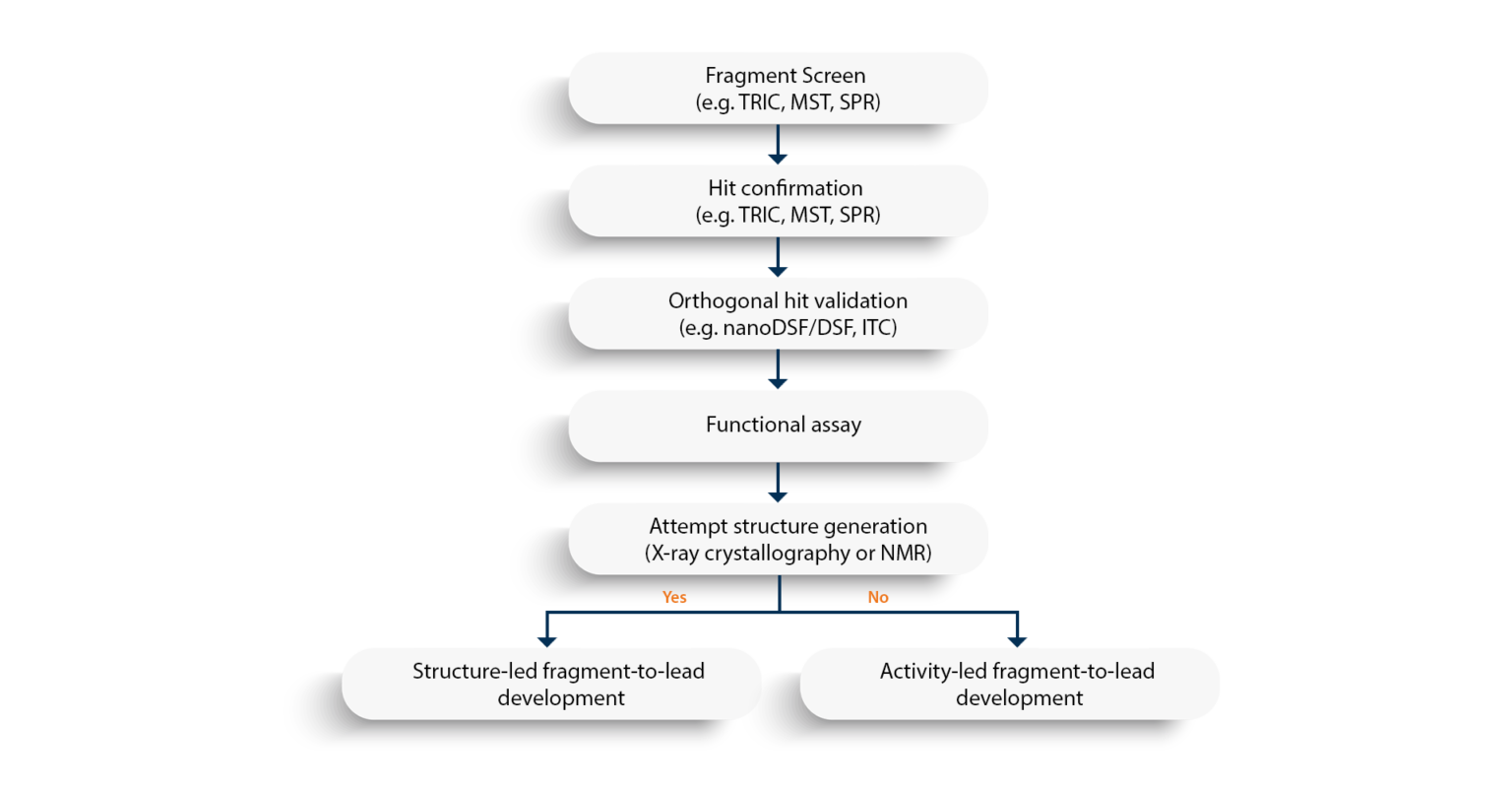
Depending on the program, the strategy may include biophysical screening, structural screening, functional or biochemical assays, conventional or covalent fragment libraries, orthogonal hit confirmation, and concentration-response testing. Confirmed fragments can then be prioritized for structural characterization and follow-up chemistry.
Example Workflow
Explore Solutions for Your Program
Explore solutions by development phase, drug modality, therapeutic area, or integrated discovery needs.
You May Also Be Interested In


Get a Quote
Ready to plan your next study? Share your program needs with our team for a tailored estimate.
Frequently Asked Questions
Fragment-based screening is a hit-finding approach that tests small, low-molecular-weight compounds for binding to a biological target. The initial interactions are often weak, so sensitive biophysical or structural methods are used for detection. Confirmed fragments can provide ligand-efficient starting points for fragment-based drug discovery.
High-throughput screening typically evaluates larger, more complex compounds and often prioritizes measurable functional activity in a large library. Fragment screening uses smaller libraries of simpler compounds and focuses first on detecting weak but efficient binding. The approaches are complementary and may identify different chemotypes or binding sites.
Fragment-based screening can be applied to many enzymes, receptors, protein-protein interactions, allosteric sites, and other targets when a suitable screening reagent and detection method are available. Target quality, stability, construct design, and assay behavior are important determinants of success. A feasibility assessment helps select the most appropriate screening strategy.
A target structure is highly valuable but is not required for the initial discovery of fragment binders. Ligand-based workflows can use biophysical and functional assays to identify and rank hits before structural information is available. When a co-structure is obtained, it can guide fragment growing, merging, linking, and optimization.
Fragments often bind weakly and are tested at relatively high concentrations, which can increase the risk of nonspecific signals, aggregation, interference, or compound-related artifacts. Repeating the result with a method based on a different physical principle increases confidence that binding is reproducible and target-dependent. Compound identity, purity, solubility, and concentration-response behavior should also be reviewed.