
Biophysical Evaluation
Biophysical Assays for Drug Discovery
Biophysical assays provide quantitative insight into how a compound interacts with its target, helping characterize binding affinity, kinetics, stability, thermodynamics, and mechanism during hit identification, hit to lead, and lead optimization. Our biophysical evaluation capabilities combine established assay platforms, fit-for-purpose protein reagents, and scientific interpretation to support compound screening, hit confirmation, and deeper characterization of drug–target interactions.
Our integrated capabilities span protein supply, assay development, biophysical measurements, and comprehensive data analysis, enabling flexible single-assay or parallel workflows tailored to your program. With validated assay systems, broad target coverage, and fast, cost-effective execution, we help you make informed discovery decisions with greater confidence.
Ready-To-Go-Assays
Quick Turn-around & Cost-Efficient Services for Multiple Drug Targets
Biophysical & Biochemical Services to Characterize Target Interaction
- Established assays: Optimized assay conditions
- Flexible: Single/multiple assays in parallel
- Cost-effective: High-quality data
- Fast Turnaround Time: Less than 2 weeks
NanoDSF – MST – SPR – ADP-Glo – Nucleotide Exchange
Protein Supply
Get established protein constructs in-house, tailored high-quality assay grade proteins, protein QC (SDS-PAGE, aSEC, MS), and complete protein supply.
Assay Initiation & Measurements
Benefit from established assay conditions, established labeling/coupling methods, published tool compounds, and up to 3 Tms / Kds / IC50s.
Results & Report
Get a tabulated report and, if desired, an extended report, including measured curves, assay conditions, analysis, and scientific summary.
Case Study: Biophysical Assays to Identify Novel K-RAS Inhibitors
K-RAS is a member of the RAS protein family — GTPases that are involved in key signaling processes and promote cell growth and proliferation. Oncogenic variants contribute to 25% of cancers, including colorectal and lung cancer. This makes the RAS family of proteins important targets for cancer treatment. After research of several decades, multiple K-RAS inhibitors (Canon et al., 2019) have opened the door to promising strategies for targeting this protein family.
To support and accelerate drug development campaigns to identify novel K-RAS inhibitors, we offer a platform for small molecule hit-finding and lead optimization, including biophysical assays and structure biology services based on established systems.
Protein Production
Broad variety of constructs for biophysical assays and crystallography established, including, but not limited to Wild type, mutants (G12C, G12D, G12V, G13D, etc.), as well as “Cys-light” variants for covalent inhibitors.
- Characterization and optimization of different KRAS-inhibitor complexes such as covalent complex formation using SPR
- Related target protein interaction partners such as SOS1 and Raf are available
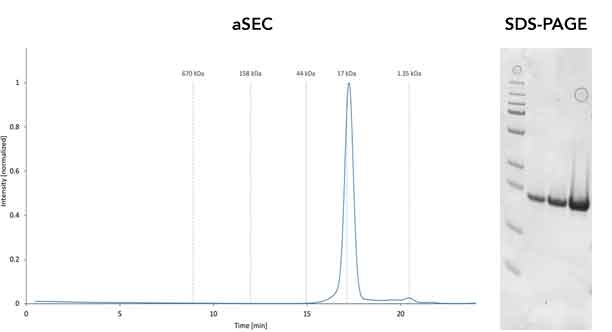
Biophysical Assays Different “Ready-to-Go” K-RAS Variants
Crystallography
- Established co-crystallization system for covalent and non-covalent small molecule inhibitors
- Non-covalent and covalent inhibitors; GDP and non-hydrolyzable GTP analog bound states
- Rapid data collection – KRAS data sets up to 1.3 Å resolution collected in-house on a Bruker MetalJet
- Established crystallization system for related targets, e.g., KRAS-inhibitor complex

Explore Solutions for Your Program
Explore solutions by development phase, drug modality, therapeutic area, or integrated discovery needs.
You May Also Be Interested In


Get a Quote
Ready to plan your next study? Share your program needs with our team for a tailored estimate.