
Hit-to-Lead Drug Discovery
Transform Screening Hits into High-Quality Drug Leads
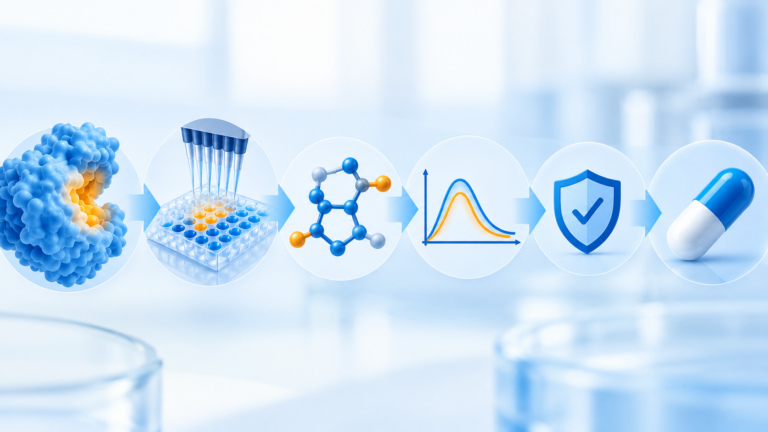
After primary screening, hundreds or even thousands of hit compounds may demonstrate measurable biological activity. Hit-to-lead optimization systematically confirms these hits, establishes structure–activity relationships (SAR), identifies early liabilities, and prioritizes compounds with the greatest potential to become lead molecules. The goal is to efficiently reduce a large pool of hits into a small number of high-quality lead compounds for further optimization.
WuXi Biology and Testing provides integrated hit-to-lead services that combine Discovery Biology, medicinal chemistry, in vitro pharmacology, DMPK, bioanalysis, and early safety assessment. Through iterative structure–activity relationship (SAR) studies and integrated biological and ADME evaluation, we help identify lead candidates with the optimal balance of efficacy, selectivity, pharmacokinetics, and developability for successful lead optimization.
Optimize More Than Potency
Balance Multiple Molecular Properties for Success
Even highly potent compounds can fail because of poor selectivity, inadequate pharmacokinetics, low solubility, metabolic instability, toxicity, or poor developability. Our integrated workflow evaluates these characteristics early, enabling informed compound prioritization, reducing late-stage attrition, and accelerating progression toward lead optimization.
Confirm Biological Activity
The first objective of hit-to-lead optimization is to confirm that screening hits represent genuine starting points for drug discovery. Through orthogonal assays, target engagement studies, mechanism of action (MOA) investigations, and early biological characterization, researchers distinguish true hits from false positives while gaining a deeper understanding of target biology. These studies establish confidence in the biological relevance of each compound before significant optimization efforts begin. Capabilities include:
- Hit confirmation
- Orthogonal assays
- Target engagement studies
- Mechanism of action studies
- Counter screening
- Biochemical assays
- Cell-based functional assays
Build Structure-Activity Relationships
Once promising hits have been confirmed, iterative structure–activity relationship (SAR) studies reveal how chemical modifications influence biological activity, selectivity, and target engagement. By integrating medicinal chemistry with biological testing, researchers identify molecular features that drive compound performance and establish a rational strategy for lead generation. This knowledge guides efficient compound design while expanding understanding of the chemical series. Capabilities include:
- Structure–activity relationship (SAR) analysis
- Analog design and synthesis
- Potency evaluation
- Selectivity profiling
- Medicinal chemistry support
- Biological characterization
- Data-driven compound design
Prioritize High-Quality Lead Candidates
Not every biologically active compound is suitable for further development. Early evaluation of physicochemical properties, ADME characteristics, and developability helps identify compounds with favorable drug-like properties while eliminating those with significant liabilities. Integrating biology and DMPK data enables informed compound prioritization and supports the selection of lead compounds for the next stage of optimization. Capabilities include:
- Early ADME profiling
- Physicochemical characterization
- Compound ranking
Selected lead compounds advance into Lead Optimization, where biological activity, pharmacokinetics, safety, and developability are further refined before candidate nomination.
Related Services
Hit-to-lead optimization depends on close integration across biology, DMPK, bioanalysis, and safety assessment. Explore our related services to see how we support every stage of early drug discovery.
Discovery Biology
Confirm hits, establish SAR, and understand target biology before selecting lead compounds.
Learn More
DMPK
Characterize ADME properties and optimize drug-like behavior early.
Learn More
Bioanalysis
Develop quantitative assays supporting pharmacology and PK studies.
Learn More
Safety Assessment
Identify early safety liabilities before candidate selection.
Learn More
You May Also Be Interested In




Discuss Your Program with Us
Share your development goals and key challenges with our experts to define the right path forward.
Frequently Asked Questions
Hit-to-lead (H2L) optimization is the process of transforming confirmed screening hits into high-quality lead compounds suitable for further drug development. It combines medicinal chemistry, biology, pharmacology, and early ADME evaluations to improve potency, selectivity, and drug-like properties while reducing development risk. The goal is to identify compounds with the best overall balance of efficacy, pharmacokinetics, safety, and developability before entering lead optimization.
Hit-to-lead focuses on confirming screening hits and improving their biological activity, selectivity, and early developability to identify promising lead compounds. Lead optimization begins after lead selection and further refines these compounds to achieve the efficacy, pharmacokinetic, safety, and manufacturability profiles required for preclinical development. Together, these stages progressively reduce risk before candidate nomination.
Hit-to-lead studies typically include biochemical assays, cell-based functional assays, mechanism of action studies, target engagement assays, selectivity profiling, and counter screening to validate biological activity. Early ADME assays such as metabolic stability, plasma protein binding, permeability, solubility, CYP inhibition, and transporter studies are also commonly performed. These data help guide medicinal chemistry efforts and prioritize compounds with the greatest development potential.
Early ADME testing identifies compounds with favorable absorption, distribution, metabolism, and excretion characteristics before extensive optimization efforts begin. Detecting issues such as poor metabolic stability, low permeability, limited solubility, or drug–drug interaction risks early allows researchers to modify compounds before costly downstream studies. Integrating ADME with biological data improves decision making and increases the likelihood of successful lead selection.
Lead compounds are selected by evaluating multiple parameters rather than potency alone. Researchers consider target activity, selectivity, mechanism of action, physicochemical properties, ADME characteristics, pharmacokinetics, safety, and overall developability. Integrating these datasets enables informed prioritization of compounds with the highest probability of successful progression into lead optimization.
Medicinal chemistry is central to hit-to-lead optimization by designing and synthesizing compound analogs that improve biological activity and drug-like properties. Guided by structure–activity relationship (SAR) data, medicinal chemists iteratively modify molecular structures to enhance potency, improve selectivity, optimize pharmacokinetics, and reduce potential liabilities. Close collaboration with biology and DMPK teams enables rapid design–make–test cycles and more efficient optimization.
Integrating biology and DMPK enables biological activity and drug-like properties to be evaluated simultaneously rather than sequentially. Combining pharmacology, ADME, bioanalysis, and early safety assessments provides a comprehensive understanding of compound performance, allowing teams to identify liabilities sooner and prioritize stronger candidates more efficiently. This integrated approach reduces project timelines, minimizes late-stage failures, and supports faster progression toward lead optimization.
Our Direct-to-Biology (D2B) platform supports the hit-to-lead process by dramatically shortening the design–make–test–analyze cycle from months to just two to three weeks. By integrating plate-based miniaturized synthesis with robust, high-throughput assays, including cell-based, biochemical, and ADMET assays, the platform generates large-scale, cost-effective experimental data and enables rapid decision-making. The high-quality datasets generated through D2B can also support predictive modeling and data-driven compound optimization.