
Metabolite Profiling and Identification (MetID)
Understand Drug Biotransformation Across Development
Metabolite profiling and identification (MetID) studies characterize how a drug is biotransformed and which drug-related components are formed in vitro, in animals, and in humans. Metabolite profiling compares the pattern and relative abundance of drug-related components, while metabolite identification assigns structures and helps define metabolic pathways.
Together, these data can reveal metabolic soft spots, active or reactive metabolites, clearance pathways, cross-species differences, and major or disproportionate human metabolites. MetID therefore supports decisions from lead optimization and candidate selection through IND-enabling development, clinical studies, safety assessment, and regulatory submission.
Why Metabolite Profiling and Identification Matter
Drug metabolism can significantly influence efficacy, safety, drug-drug interaction (DDI) potential, and clinical exposure. Early metabolite identification helps researchers understand how a compound is transformed in biological systems and whether metabolites may contribute to pharmacological activity, toxicity, or regulatory concerns.
MetID studies support metabolic soft spot identification, active and reactive metabolite assessment, human metabolite characterization, cross-species metabolism comparisons, metabolites in safety testing (MIST) evaluations, and IND/NDA submissions.
MetID Across the Drug Development Journey
From discovery through clinical development, our drug development process includes:
- Lead Optimization: Identify metabolic soft spots and screen for reactive or potentially problematic metabolites to guide structural optimization.
- Candidate Selection: Compare in vitro and in vivo metabolic profiles across species and characterize major metabolites to support candidate and species selection.
- IND-Enabling Development: Define major metabolic and clearance pathways, assess cross-species metabolite coverage, and prepare for later human metabolite and MIST evaluations.
- Clinical Development: Profile and identify metabolites in human plasma and excreta from first-in-human (FIH), single ascending dose (SAD), and multiple ascending dose (MAD) studies to characterize human exposure and clearance pathways.
- Registration: Integrate nonclinical and clinical metabolite data, including radiolabeled ADME or mass-balance information when applicable, to support metabolite characterization and regulatory submissions.
Comprehensive Metabolite Profiling & Identification Services
We support non-radiolabeled and radiolabeled metabolite profiling and identification from discovery through clinical development. Services include in vitro and in vivo MetID, human clinical MetID, cross-species metabolism comparison, MIST support where applicable, metabolite biosynthesis and isolation, and structural characterization using high-resolution mass spectrometry (HRMS) and complementary techniques.
Our Capabilities
In Vitro Metabolite Identification and Biotransformation:
- Metabolic soft spot analysis and identification
- Reactive metabolite trapping (glutathione, cysteine, methoxamine, etc.)
- MetID in liver microsomes, hepatocytes, S9 fractions, plasma, blood, and tissue homogenates, with additional systems such as kidney, lung, or intestinal microsomes, lysosomal preparations, recombinant enzymes, or tumor cells used when scientifically appropriate.
In Vivo and Human Metabolite Identification:
- Animal MetID in plasma or blood, urine, feces, bile, tissues, and other relevant matrices to characterize metabolite exposure and clearance pathways.
- Human MetID in plasma, urine, feces, and other available clinical matrices to identify major circulating or excreted metabolites and compare human metabolite exposure with nonclinical species.
Metabolites in Safety Testing (MIST)
For small-molecule programs where MIST considerations apply, human metabolites may require additional evaluation when they are unique or disproportionate in humans relative to the species used in standard nonclinical toxicology studies. The objective is to determine whether clinically relevant human metabolite exposures have been adequately represented in the nonclinical safety program.
We support MIST-related assessments through human and animal metabolite profiling, cross-species exposure comparison, metabolite quantification or relative exposure assessment, structural characterization, and coordination with safety assessment teams when additional qualification is needed.
Metabolite Biosynthesis, Isolation, and Structure Elucidation
- In vitro biosynthesis and structural characterization of target metabolites
- In vivo biosynthesis and structural characterization of target metabolites
- LC-HRMS, UV, NMR, and specialized structural-elucidation approaches for confirmation of metabolite structures
Metabolite biosynthesis and isolation can provide material for structural confirmation and follow-up pharmacology, bioanalysis, or safety studies when needed.
Metabolite Identification for Emerging Drug Modalities
We support metabolite profiling and biotransformation characterization for conventional small molecules and emerging modalities, including PROTACs, oligonucleotides, antibody-oligonucleotide conjugates (AOCs), antibody-drug conjugates (ADCs), peptide-drug conjugates (PDCs), peptides, polymers, and radiolabeled compounds. Because these modalities can undergo different biotransformation or catabolic pathways, incubation systems, sample preparation, mass-spectrometric acquisition, and data interpretation can be adapted to the molecule and study objective.
Why Partner With Us
- Thousands of metabolite identification studies annually
- Discovery-to-clinical development support
- Dedicated metabolite biosynthesis capabilities
- Expertise in conventional and emerging modalities
- Integrated DMPK, bioanalysis, safety assessment, and regulatory support
- Advanced HRMS platforms and structural characterization expertise
- Experienced scientists with extensive metabolism and medicinal chemistry backgrounds
High-Resolution Mass Spectrometry for MetID
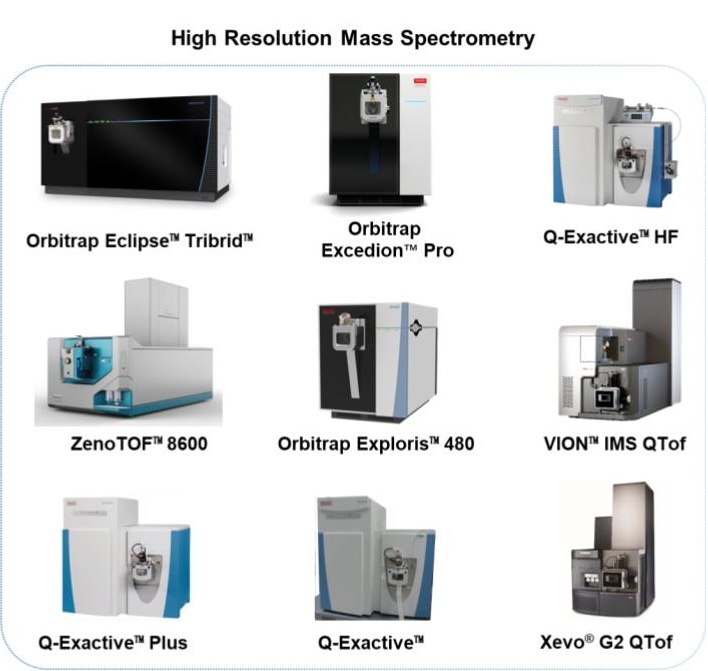
High-resolution mass spectrometry supports accurate-mass detection, metabolite profiling, MS/MS-based structural assignment, and characterization of low-abundance or complex metabolites. Available platforms include Orbitrap Eclipse Tribrid, Orbitrap Excedion Pro, Orbitrap Exploris 480, Q Exactive HF, Q Exactive Plus, ZenoTOF 8600, and other advanced LC-HRMS systems, complemented by specialized data-processing workflows.

Explore Solutions for Your Program
Explore solutions by development phase, drug modality, therapeutic area, or integrated discovery needs.
You May Also Be Interested In



Get a Quote
Ready to plan your next study? Share your program needs with our team for a tailored estimate.