
Large Molecule GLP Bioanalysis
Streamline Your IND With Expert Bioanalysis
Work with seasoned specialists who provide the regulatory-compliant preclinical bioanalytical testing essential for your IND application. WuXi Biology and Testing’s robust analytical suites for large molecules encompass every phase of the development lifecycle, streamlining your progression toward clinical trials.
Preclinical Bioanalytical Studies to Support IND Submission
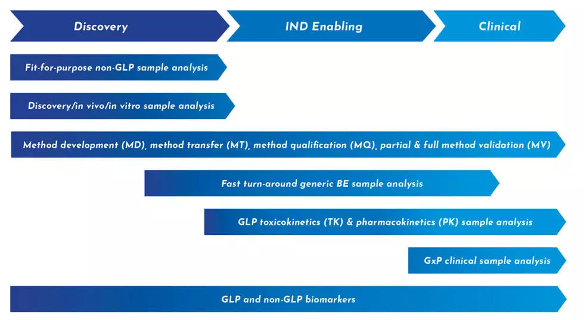
Our preclinical bioanalytical team brings decades of experience advancing large molecule compounds for IND submission. As an end-to-end partner, we use insights from discovery efforts to eliminate the need to transfer a compound from one unit to another, significantly reducing timelines.
- 340+ preclinical biomarkers for small and large molecules
- 60,000 samples per month capacity
- 20,000 square feet of GLP lab space
- State-of-the-art mass spectrometry platforms with UHPLC-MS/MS capabilities
- Automated and semi-automated high-throughput-capable systems including Janus®, TomTec® CyBio®-SELMA\
- 21 CFR Part 11-compliant validated systems; Analyst®, MassLynx™, Watson LIMS™
Large Molecule GLP Bioanalysis Capabilities
We support large molecule development through a robust immunochemistry platform that covers biologics, biomarkers and vaccines. Operating out of 20,000 square feet of GLP laboratory space, our team can handle over 60,000 samples per month, and has validated more than 300 preclinical biomarker assays to support your large molecule programs.
- 70+ Antibody
- 10+ ADC
- 30+ Fusion Proteins
- 40+ Recombinant Proteins
- 35+ Peptides (including Conjugated)
- 10+ Other
Your Immunogenicity Assessment Journey
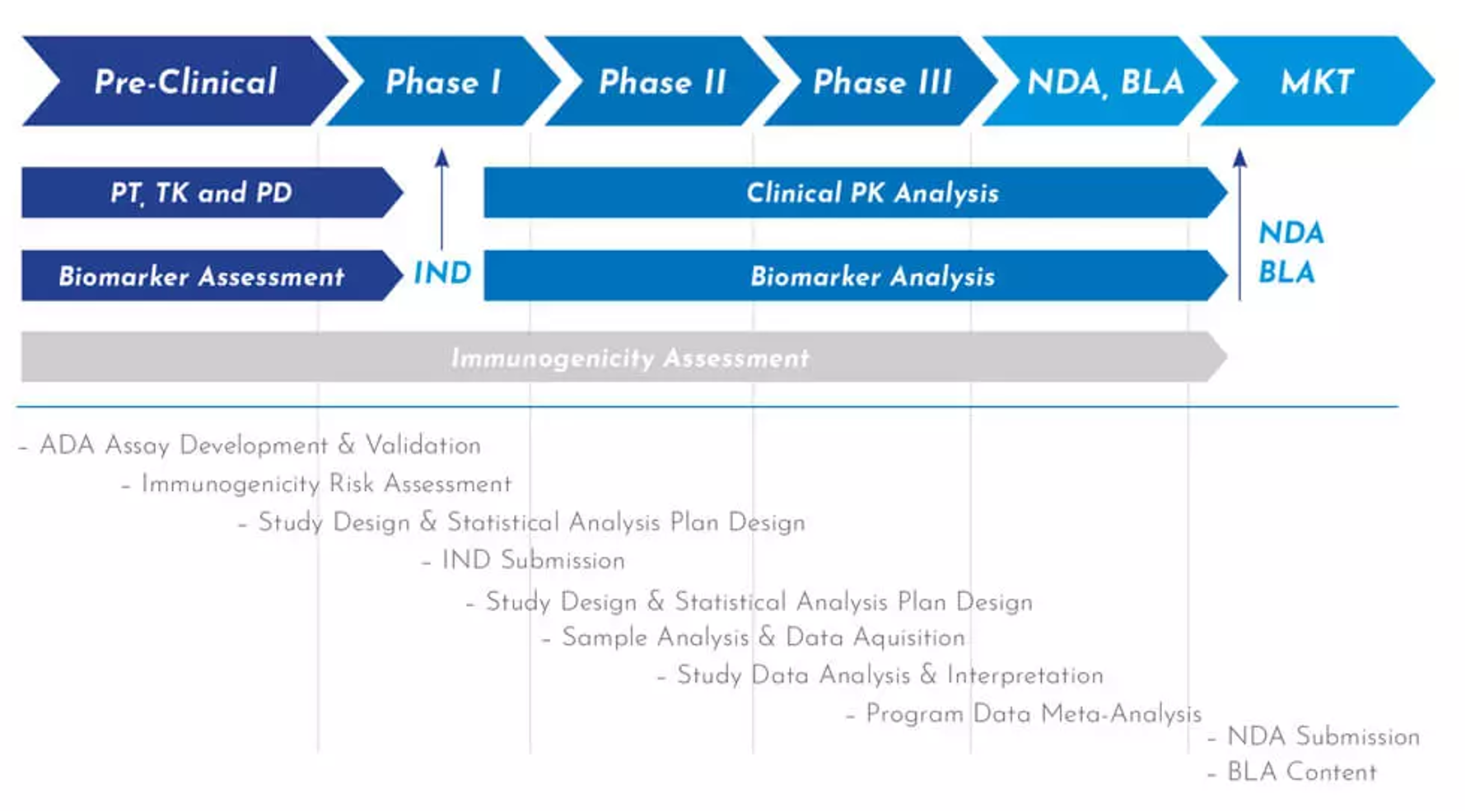
Biotherapeutics present many challenges in drug development compared to small molecule drugs. As a result, regulatory agencies require extensive immunogenicity testing in an IND package that, left unaddressed, can lead to clinical delays. To avoid this scenario, we help you develop custom reagents and assays that analyze key measures of the immune response, and provide expert support in executing the multi-tiered testing that adheres to regulatory agency immunogenicity guidelines.
Custom Bioreagent Antibodies & Proteins Development
We develop custom reagents to support your candidate in the assessment of immunogenicity, PK and PD bioanalytical services. Once validated, they can rapidly analyze therapeutic candidates, to advance development efforts.
- Monoclonal
- Polyclonal
- Recombinant Proteins
- Peptides

Explore Solutions for Your Program
Explore solutions by development phase, drug modality, therapeutic area, or integrated discovery needs.
You May Also Be Interested In


Get a Quote
Ready to plan your next study? Share your program needs with our team for a tailored estimate.
Large Molecule Discovery Bioanalysis FAQs
Large molecule GLP bioanalysis involves the rigorous, compliant measurement of protein-based therapeutics and biologics to support safety and toxicology studies under Good Laboratory Practice (GLP) standards.
GLP bioanalysis adheres to strict regulatory mandates and comprehensive method validation to ensure complete data integrity for regulatory filings, whereas non-GLP bioanalysis offers greater flexibility and speed for early research.
Supported modalities include monoclonal antibodies, antibody-drug conjugates, fusion proteins, therapeutic peptides, and other complex macromolecular structures.
Industry standards include ligand-binding assays such as ELISA and electrochemiluminescence (ECL) platforms, alongside specialized mass spectrometry methods.
Methods undergo formal validation adhering to regulatory guidelines, systematically establishing parameters like accuracy, precision, specificity, and stability to ensure reliable study support.
It detects anti-drug antibodies (ADAs) and neutralizing antibodies, which are critical for interpreting drug exposure, clearance, and potential safety or efficacy impacts.
Commonly analyzed matrices include serum, plasma, and specialized tissue samples collected during formal preclinical safety evaluations.
It generates the regulatory-grade pharmacokinetic and toxicokinetic data required to establish safety margins and justify initial clinical dosing strategies in an IND application.
A program should transition when moving out of the early exploratory phase and preparing to execute pivotal, GLP-compliant toxicology studies required for regulatory submission.