
Early Toxicity and Safety Screening
Identify Safety Liabilities Earlier
Early identification of potential safety liabilities can help guide compound optimization, differentiate candidates, and reduce the risk of unexpected toxicity emerging later in development. Integrating safety evaluation with pharmacology and efficacy studies enables the investigation of potential risks while compounds can still be optimized or deprioritized.
WuXi Biology and Testing provides integrated early toxicity and safety screening capabilities spanning secondary pharmacology, cellular and organ-specific toxicity, genetic toxicology, and mechanistic follow-up studies. Flexible screening strategies support development from hit-to-lead through candidate selection, providing a bridge to IND-enabling safety assessment.
Integrated Early Safety and Toxicity Profiling
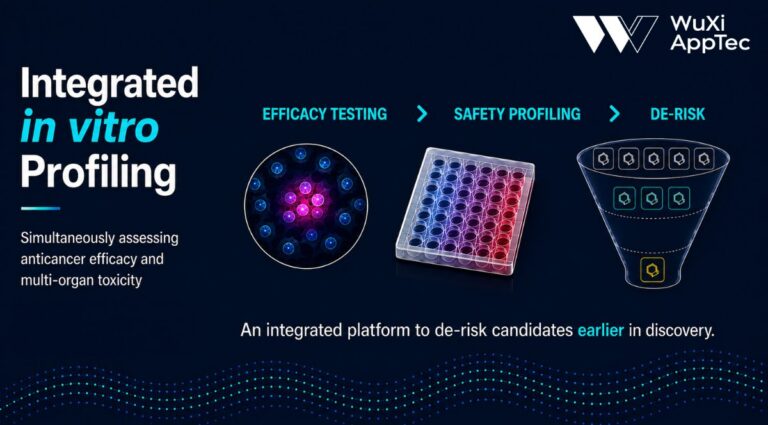
Evaluate pharmacological activity and potential toxicity in parallel to better understand therapeutic windows and support informed candidate selection.
WuXi Biology's integrated in vitro profiling capabilities with cellular and organ-specific toxicity assessments. By comparing efficacy and toxicity concentration-response data, compounds can be differentiated based on their in vitro therapeutic index, helping identify candidates with wider safety margins and more favorable efficacy-to-safety profiles.
Integrated profiling can incorporate:
- Normal-cell cytotoxicity
- Organ-specific toxicity assessment
- Mitochondrial toxicity
- Phototoxicity
- Genotoxicity
- Therapeutic-window and therapeutic-index assessment
Off-Target and Secondary Pharmacology Profiling
Approximately 75% of adverse drug reactions are dose-dependent, related to the pharmacological action of the drug, and predictable. Secondary pharmacology profiling can help identify unintended interactions with safety-relevant targets early in discovery, supporting hazard identification, lead optimization, and candidate selection.
WuXi Biology provides in vitro safety pharmacology profiling using radioligand binding (plate filtration or SPA), functional (FLIPR Ca²⁺, reporter gene), and biochemical (enzymatic) assays across receptors, ion channels, enzymes, transporters, and other safety-relevant targets.
Safety Profiling Panels
- Mini Safety 44 Panel: 44 targets associated with the most serious ADRs; recommended in discovery for early hazard identification
- Safety Extra 54 Panel: 54 additional targets combining low-hit-rate/high-risk and high-hit-rate/lower-risk ADR profiles; suited to broad characterization of a limited number of compounds in lead selection
- Full Safety 98 Panel: combined Mini Safety 44 and Safety Extra 54 coverage
- Follow-up 8–10 point concentration-response testing to confirm hits (>50% inhibition or activation vs. control)
- Flexible target selection and customized profiling strategies, expandable to other formats (e.g., cAMP, IP1)
The Mini Safety 44 Panel comprises 24 GPCRs, eight ion channels, seven enzymes, three monoamine transporters, and two nuclear hormone receptors. The Safety Extra 54 Panel expands coverage to include 26 GPCRs, five ion channels, 18 enzymes, three nuclear hormone receptors, and two transmembrane targets.
In Vitro Toxicity and Organ-Specific Safety
Identify and characterize potential cellular and organ-specific safety liabilities using fit-for-purpose in vitro models and endpoints. WuXi Biology and Testing offer capabilities across cardiac, hepatic, renal, pulmonary, neurological, mitochondrial, phototoxic, and general cytotoxicity assessments for early hazard identification, compound optimization, and candidate selection.
Advanced cellular and 3D models can be incorporated where appropriate, and toxicity data can be evaluated alongside pharmacological activity to characterize therapeutic windows and differentiate candidates.
Genetic Toxicology Screening
Identify potential genetic toxicity liabilities during drug discovery to support early hazard identification, compound optimization, and candidate selection.
WuXi Biology and Testing provides genetic toxicology capabilities spanning early screening and mechanistic follow-up, from non-GLP to GLP-compliant studies that support regulatory development. Early evaluation can help identify potential liabilities for mutagenic or chromosomal damage and inform subsequent testing strategies.
From Early Safety Screening to IND-Enabling Safety Assessment
Early safety findings can be considered alongside pharmacology, efficacy, and DMPK data to support compound optimization, candidate selection, and planning for subsequent nonclinical development.
As candidates advance, WuXi Biology and Testing provide continuity from discovery-stage safety screening into comprehensive IND-enabling safety assessment. This integrated approach supports progression from early hazard identification and mechanistic characterization through candidate selection and regulatory safety evaluation.

Explore Solutions for Your Program
Explore solutions by development phase, drug modality, therapeutic area, or integrated discovery needs.
You May Also Be Interested In


Get a Quote
Ready to plan your next study? Share your program needs with our team for a tailored estimate.
Frequently Asked Questions
Early toxicity and safety screening uses in vitro, cellular, and other nonclinical approaches to identify potential safety liabilities during drug discovery. We can evaluate normal-cell cytotoxicity, organ-specific toxicity, mitochondrial toxicity, genetic toxicity, phototoxicity, therapeutic-window and therapeutic-index, and other potential risks before compounds progress into formal regulatory toxicology studies.
Early toxicity testing can begin during hit-to-lead and expand through lead optimization and candidate selection. WuXi Biology’s high-throughput in vitro toxicology assays in 96- or 384-well format enabling parallel safety profiling alongside efficacy and DMPK screening from the earliest discovery stages. The timing and scope of testing depend on the compound, target biology, anticipated exposure, and known or suspected safety liabilities.
Secondary pharmacology profiling evaluates interactions between a compound and targets other than its intended therapeutic target. Screening against safety-relevant receptors, ion channels, enzymes, transporters, and other targets using radioligand binding, functional, and biochemical enzymatic assays can help identify unintended pharmacological activity and support compound optimization and candidate selection.
The WuXi Mini Safety 44 Panel profiles compounds against 44 safety-relevant targets, including 24 GPCRs, eight ion channels, seven enzymes, three monoamine transporters, and two nuclear hormone receptors. It is designed to support early hazard identification for compounds associated with the most serious ADRs, with additional 54-target and combined 98-target panels available for broader safety pharmacology profiling.
In vitro approaches can investigate potential cardiac, hepatic, renal, pulmonary, neurological, mitochondrial, lysosomal, phototoxic, genetic, hematotoxicity, and general cytotoxic liabilities. Fit-for-purpose assays and models can be selected based on the compound and the specific safety question.
Early safety findings can be evaluated alongside potency, selectivity, efficacy, and DMPK data to differentiate compounds and identify potential liabilities. Detecting these signals before candidate nomination provides an opportunity to investigate mechanisms, optimize compounds, or select candidates with more favorable profiles.
No. Early toxicity and safety screening supports hazard identification, compound optimization, and candidate selection. Formal nonclinical safety studies are subsequently conducted according to the candidate, therapeutic modality, clinical development strategy, and applicable regulatory requirements.