
Repeat-Dose Toxicity Testing
Long-Term Safety and Target Organ Risks
Repeat-dose or chronic toxicity studies help evaluate the effects of repeat administration of a new drug candidate over a defined period of time. These critical evaluations help you select proper dosing amounts for subsequent GLP studies and identify potential target organs affected by your compound. As an experienced partner in general toxicology testing, WuXi Biology and Testing can help you build a safety assessment program that includes the correct repeat dose toxicity testing protocols for your needs.
By the Numbers
General Toxicology Studies Performed
Square Feet of Facilities
Study Rooms
Repeat-Dose Toxicity Testing Capabilities
We offer end-to-end toxicology testing for all stages of your drug development lifecycle, including IND-enabling, subchronic, and chronic repeat dose studies.
Repeat-Dose Toxicity Testing Species and Routes of Administration
Our experienced team can help you design repeat dose toxicity testing programs utilizing the right toxicological species, dose levels, routes of administration, analyses, and regulatory support tailored to your project.
Species
- Canine
- Mouse
- Rat
- Rabbit
- NHP
- Swine
Routes of Administration
Our cutting-edge facilities are stocked with some of the most advanced bioanalytical equipment in the world.
- Intravenous (bolus, infusion)
- Oral (gavage, capsule) and nasogastric (for NHPs)
- Topical
- Intramuscular
- Subcutaneous
- Intradermal
- Ocular (including systemic, topical, subconjunctival, intravitreal, sub-retinal and retrobulbar)
- Implant
- Other (upon request)
- Intrathecal
- Intra-articular
- Intraperitoneal
- Intra-arterial
Other General Toxicology Studies
Repeat-dose chronic toxicity studies are part of a complete general toxicology program. You can evaluate the safety and potential adverse effects of new compounds and products with our comprehensive service platform. Our other studies include:
Repeat-Dose Toxicity Data
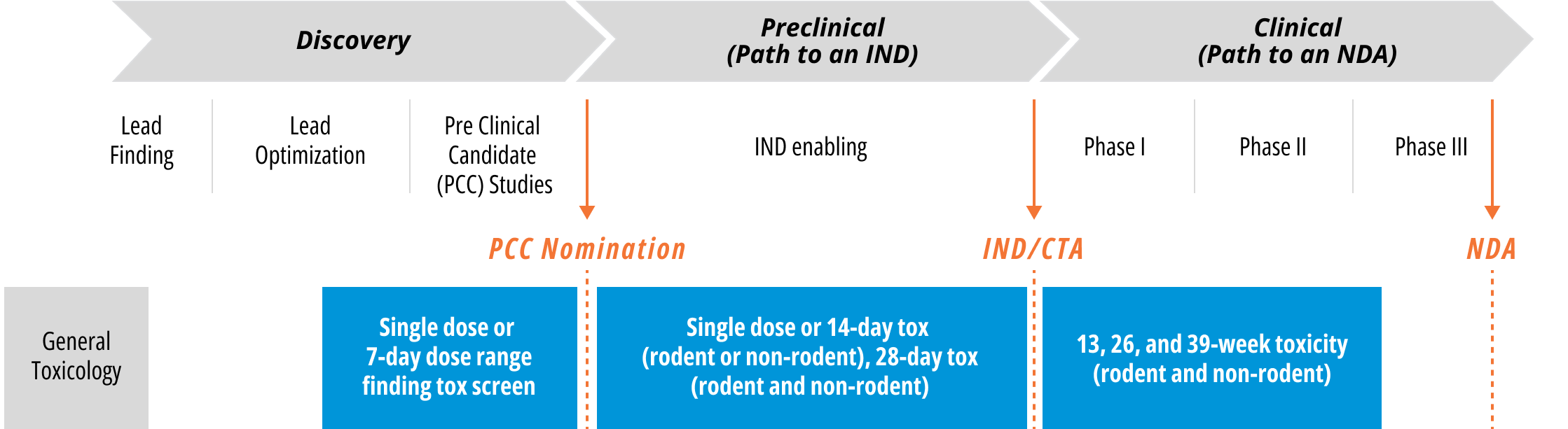
Repeat-dose toxicity studies generate data that deepen your understanding of dose and toxicity parameters for a given compound. This chronic toxicity data helps identify correct dosing levels for pivotal, later-stage GLP studies. Our repeat-dose toxicity testing protocols serve as a critical component of the drug development lifecycle, playing vital roles through the discovery, preclinical-to-IND, and clinical stages.
Repeat-Dose Toxicity Testing Durations
The U.S. FDA’s “M3(R2) Nonclinical Safety Studies for the Conduct of Human Clinical Trials and Marketing Authorization for Pharmaceuticals” provides guidance on the recommended length of repeat-dose toxicity studies. We can help you select the right duration that matches or exceeds your clinical dosing period.
Acute
Determines if subjects can tolerate a dose level over a shorter time period. Used for maximum tolerated dose (MTD) screening studies. Timeframe: 2 weeks or less.
Sub-Chronic
Shows a more complete safety profile, evaluating clinical observations, clinical chemistry, histology, and target organ hematology effects. Timeframe: 4 to 13 weeks.
Chronic
Assesses long-term biological safety parameters and the potential for lifelong health impacts, including carcinogenicity and chronic diseases. Timeframe: 6 to 9 months or 1–2+ years.

Explore Solutions for Your Program
Explore solutions by development phase, drug modality, therapeutic area, or integrated discovery needs.
You May Also Be Interested In





Get a Quote
Ready to plan your next study? Share your program needs with our team for a tailored estimate.
Frequently Asked Questions
Repeat-dose toxicity studies test the safety of a new drug candidate by exposing animals to repeated doses of the compound and monitoring for signs of toxicity over the course of 14-28 days.
Repeat-dose toxicity studies evaluate the effects of repeat administration over a defined period of time. The studies will provide detailed information about the potential target organs of toxicity, the exposure, as well as the potential of toxic effects.
The studies will provide information about the toxicity of the organs effected by the compound. The repeated-dose toxicity studies are essential for the quantitative risk assessment of drug molecules.