
Neuroscience Disease Models
Accelerate Discovery with In Vitro and Ex Vivo Neuroscience Disease Models
Advance neuroscience drug discovery with disease-relevant in vitro and ex vivo models designed to characterize target biology, therapeutic activity, functional response, and CNS drug safety.
WuXi Biology and Testing combines target-based and cellular assays with primary neuronal and glial cultures, ex vivo brain tissue models, human iPSC-derived systems, and human brain organoids to support mechanistic and translational studies. From early screening and SAR through functional validation, our neuroscience platform provides complementary biochemical, molecular, cellular, and electrophysiological readouts to help characterize therapeutic effects in CNS- and PNS-relevant systems.
Neuronal and Glial Cell-Based Models
Neuronal and glial cell-based models enable the evaluation of therapeutic activity and disease-relevant phenotypes in physiologically relevant neural systems. Using primary neurons, glial cells, and established neuronal cell lines, these assays support investigations into neuroprotection, neuroinflammation, neuronal function, and mechanisms of action across neuroscience drug discovery programs.
Capabilities include:
- Primary cortical and hippocampal neurons
- DRG neurons and motor neurons
- Astrocytes and microglia
- Neuronal cell lines
- Neuron-glia culture systems
- Neuroprotection and neurotoxicity models
- Neurite outgrowth assays
- Neuroinflammation models
- Disease-relevant cellular challenges such as Aβ, glutamate, OGD and LPS
Human iPSC-Based Neuroscience Models
Human iPSC-derived neuronal and glial models and human brain organoids provide human-relevant systems for investigating disease biology, therapeutic mechanisms, and functional responses in neuroscience research.
Capabilities include:
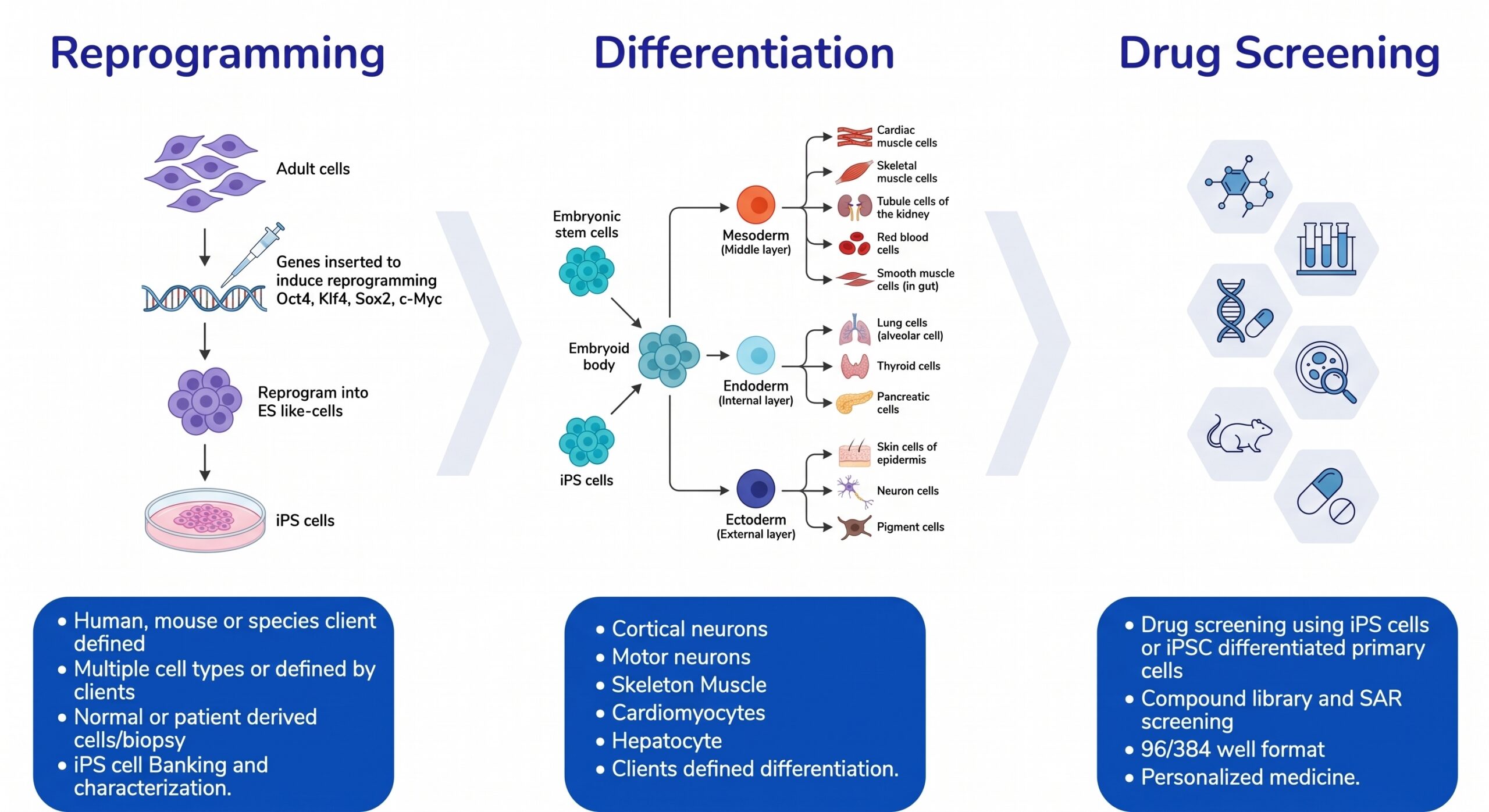
- iPSC reprogramming and differentiation
- hiPSC-derived neurons
- hiPSC-derived glial cells
- Neuron-glia cultures
- 3D culture systems
- Human brain organoids
- Disease modeling
- Compound screening
- Mechanistic and functional studies
Electrophysiology and Neuronal Function
Electrophysiological assays characterize compound effects on ion channels, neuronal excitability, synaptic activity, and network function across recombinant and disease-relevant neuronal systems.
Capabilities include:
- Manual patch clamp
- Automated patch clamp
- Multi-electrode array (MEA)
- Neuronal firing and network activity
- Network bursting, connectivity, and synchrony
- Ion channel functional characterization
Pharmacological, Molecular and Biochemical Assays
Complementary pharmacological, molecular, and biochemical assays characterize target activity, cellular responses, and mechanisms of action to support screening, profiling, and candidate characterization.
Capabilities include:
- GPCR functional and binding assays
- Ion channel assays
- Transporter uptake assays
- Enzyme activity assays
- Cell viability and apoptosis
- Inflammatory gene-expression analysis
- Aβ aggregation and oligomerization assays
- Target deconvolution and mechanism-of-action studies
Ex Vivo Neuroscience Models
Ex vivo neural tissue models preserve native tissue architecture, cellular interactions, and functional connectivity, providing a bridge between cellular assays and in vivo neuroscience studies.
Capabilities include:
- Acute brain-slice preparations
- Organotypic brain slice cultures
- Brain-slice patch-clamp electrophysiology
- Assessment of neuronal and synaptic function
- Pharmacological evaluation in neural tissue
- Tissue-based molecular and biomarker analysis
Histological and Morphological Studies
Histological, imaging, and morphological studies provide complementary readouts to characterize neuronal and glial phenotypes, tissue responses, and pharmacodynamic effects.
Capabilities include:
- Neurite outgrowth and neuronal morphology
- High-content imaging
- H&E and special staining
- IHC
- Immunofluorescence and multiplex IF
- ISH/RNAscope
- Digital pathology and quantitative image analysis
Neuroscience Target-Based Assays
Voltage and ligand-gated ion channels
- Over 50 stable cell lines
- Automated and manual patch-clamp assays
- Radioligand binding assays
Transporters
- Uptake assays
G protein-coupled receptors (GPCR)
- Over 120 stable cell lines
- Functional assay and binding assay
Enzymes
- Strong expertise of enzymology in drug discovery
iPSC Capability
Explore Solutions for Your Program
Explore solutions by development phase, drug modality, therapeutic area, or integrated discovery needs.
You May Also Be Interested In
Get a Quote
Ready to plan your next study? Share your program needs with our team for a tailored estimate.