
What Is Integrated Drug Discovery and Development? From Target Biology to Candidate Selection
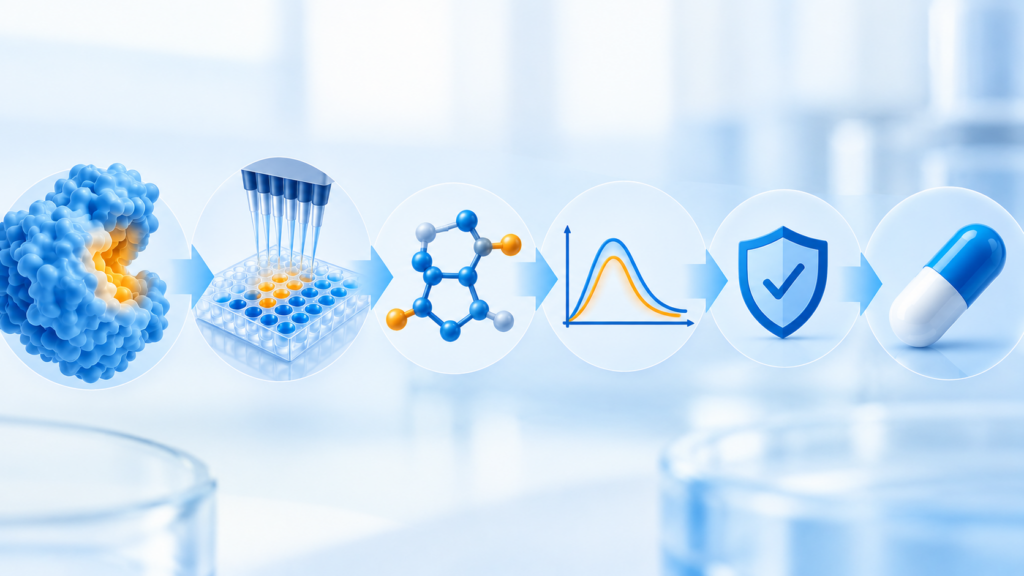
Integrated drug discovery and development is a coordinated approach to drug development that connects target biology, screening and hit identification, medicinal chemistry, in vitro and in vivo pharmacology, DMPK, bioanalysis, and toxicology. Rather than evaluating each discipline in isolation, an integrated approach uses data across these areas to inform go/no-go decisions, identify potential liabilities earlier, and guide promising compounds toward candidate selection and nonclinical development.
Throughout this process, drug discovery teams must answer a series of interconnected questions, for example:
- Is the protein, gene, receptor, enzyme, or biological pathway we’re targeting causing or sustaining this disease?
- If so, would changing its activity help treat the disease?
- Will the drug we're developing impact the target in the intended way?
- Can our drug reach the right tissue and keep the patient safe?
The answers to these questions affect every stage of drug discovery, which is why the process is seldom straightforward. Problematic findings in early ADME (absorption, distribution, metabolism, and excretion) or toxicology testing can send preclinical candidates back to lead optimization or, in rare cases, all the way back to target validation.
Biotech startups, pharmaceutical companies big and small, and academic innovators all require specialized capabilities to achieve their drug development goals. Integrated drug discovery provides a collaborative, coordinated way to get there.
How Does Integrated Drug Discovery Work?
It is easiest to think of the drug development journey like a funnel. Lead compounds are continuously analyzed and vetted as they progress to each subsequent stage. The data collected through that process helps support a developer or sponsor’s Investigational New Drug (IND) application.
Target Identification, Validation, and Druggability
Drug discovery begins by identifying disease-relevant biological targets and generating evidence that modulating them could produce a therapeutic effect. Biological relevance alone, however, does not ensure that a target is therapeutically tractable. Assessing druggability helps determine whether and how a target can be effectively modulated by an appropriate therapeutic modality.
Hit Finding and Hit Identification
Once a target and therapeutic strategy are established, screening approaches such as high-throughput screening, fragment-based screening, DNA-encoded libraries, and other complementary methods can be used to identify potential starting molecules. Hits are then confirmed and characterized to determine which are suitable for further optimization.
Hit-to-Lead and Lead Optimization
Confirmed hits are evaluated and optimized across potency, selectivity, physicochemical properties, ADME, and other characteristics. The objective is to identify lead series with a balanced profile that supports further development.
Candidate Selection and Nonclinical Development
As compounds advance, pharmacology, DMPK, bioanalysis, and safety data increasingly inform candidate selection. Integrating these data helps determine whether exposure, pharmacological activity, and safety characteristics collectively support continued development.
Maintaining a drug program’s timeline throughout these stages requires myriad moving parts and organizational capabilities. The result of an integrated approach that aligns resources and strategies across all phases is fewer preclinical development failures, shortened project timelines, and high-quality data packages that withstand regulatory scrutiny.
How Does Integrated Drug Discovery Support Go/No-Go Decisions?
Go/no-go decisions rarely depend on a single data point. Target biology, potency and selectivity, ADME/PK, pharmacological activity, and early safety findings must be considered together to determine whether a compound should be optimized, advanced, or deprioritized.
Integrated drug discovery can help by coordinating target identification and validation, hit-to-lead optimization, drug metabolism and pharmacokinetics (DMPK), bioanalysis, and toxicology around a series of questions that a drug candidate must answer before moving to the next stage. Complete data transparency among those conducting these tasks also improves communication and helps everyone identify risks before they become expensive downstream setbacks. Finally, harmonized study design and program management can also reduce operational friction that is so common when programs are patchworked together using separate teams or disparate vendors.
Integrated programs also benefit from coordinated study planning, consistent data interpretation, and communication across scientific disciplines. These connections become increasingly important as programs progress from early discovery toward candidate selection and IND-enabling development.
A Final Word
Integrated drug discovery brings together biological, pharmacological, DMPK, bioanalytical, and safety evidence to support decisions throughout the discovery process. By considering these data collectively, development teams can identify liabilities earlier, refine experimental strategies, and build greater confidence in decisions about which compounds to optimize and advance.
As programs progress from target validation through hit finding, lead optimization, candidate selection, and nonclinical development, the scientific questions change, but the value of connecting data across disciplines remains.
You May Also Be Interested In


Discuss Your Program with Us
Share your development goals and key challenges with our experts to define the right path forward.